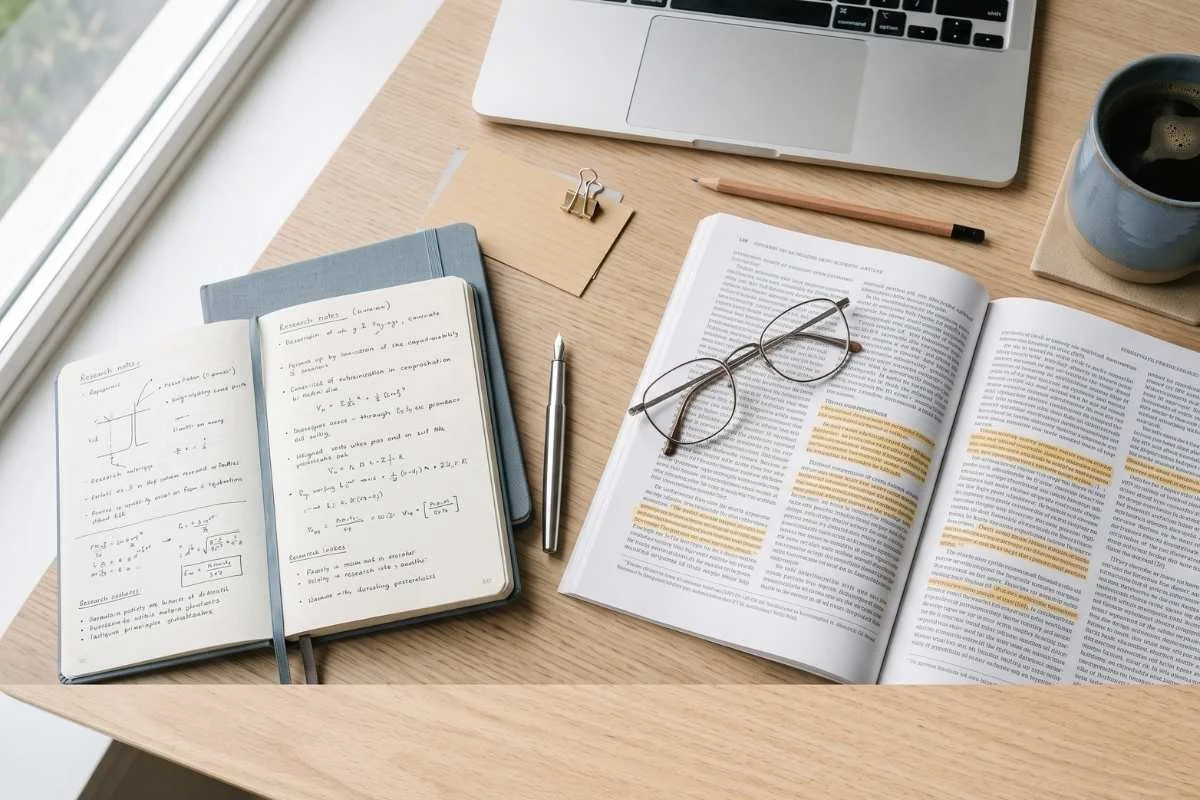
How I read and write about research
This page explains how everything on this site is researched, written and reviewed. It exists so you can decide for yourself whether to trust what you read here.
Who writes it
Everything is written by me, Bella Katahanas. I hold a Bachelor of Biomedical Science and a Masters of Clinical Epidemiology.
Clinical epidemiology is the science of how we know what we know in medicine. It is the study of how health outcomes occur across populations and what actually drives them. The clinical side is specifically about evaluating evidence: how to read a study properly, understand risk, and work out whether a finding is meaningful or whether it is noise.
That training is the reason I go straight to the primary research rather than waiting for it to filter through a headline.
There are no ghostwriters here and no AI-generated articles published under my name.
What I read
Primary sources wherever possible. Peer-reviewed papers, systematic reviews and clinical guidelines. Not press releases, and not other people's summaries.
For Australian guidance I go to the NHMRC, RANZCOG, the Australian Immunisation Handbook, ATAGI, NCIRS, ARPANSA, MotherSafe, the TGA, and the Department of Health's Clinical Practice Guidelines: Pregnancy Care.
I read the full paper, not the abstract. The abstract is where findings get flattered.
How I weigh evidence
Not all studies are equal, and I will always tell you which kind you are looking at.
Systematic reviews and meta-analyses carry the most weight. They pool what is already known rather than resting on a single result.
Randomised controlled trials can show cause and effect, because the only thing separating the groups is the intervention.
Observational and cohort studies show associations, not causation. They can tell you two things occur together. They cannot tell you one caused the other. I say so every single time.
Animal and laboratory studies are hypothesis-generating. They tell us what might happen in a rat, often at a dose or exposure no human would ever encounter. I flag these clearly and never present them as human evidence.
I also look at who funded the research. Industry-funded studies are not automatically wrong, but you deserve to know, so I tell you.
The distinction that matters most
Measuring a biological effect is not the same as demonstrating harm.
This is the single most common way alarming health content misleads people. A study detects a change in a cell, or a marker, or a rat, and it gets reported as though something has been shown to hurt you. Those are entirely different claims.
Whenever I cover research like that, I will name which one it is.
What I will not do
Publish a statistic I cannot trace to a source. If I cannot verify it, it does not run, or it runs with the uncertainty stated plainly.
Report a relative risk without context. "A 26% higher risk" sounds alarming and often describes a very small change in absolute terms. Both numbers matter, so you get both.
Turn a preliminary finding into a headline. Emerging is not established.
Give individual medical advice, name a dose for your situation, or recommend supplement brands.
Accept payment to cover a topic, or to cover it in a particular way. If any content is ever sponsored or gifted, it will be disclosed clearly and up front.
Corrections
I get things wrong sometimes.
When I do, I correct the article, note what changed and date it. I would far rather be corrected than be confidently wrong, so if you spot an error, please tell me and include a source if you have one.
Reviews and updates
Guidelines change. Every article carries a published date and a last reviewed date, and I revisit articles when guidance shifts.
If a review date looks old, treat the content as potentially out of date and check with your care team.
The line I will not cross
Everything here is education, not medical advice.
It is designed to help you ask better questions of your GP, midwife or obstetrician. It is not designed to replace them, and it cannot, because they know your history and I do not.
Read the full disclaimer.