CoQ10 and egg quality: what the evidence says
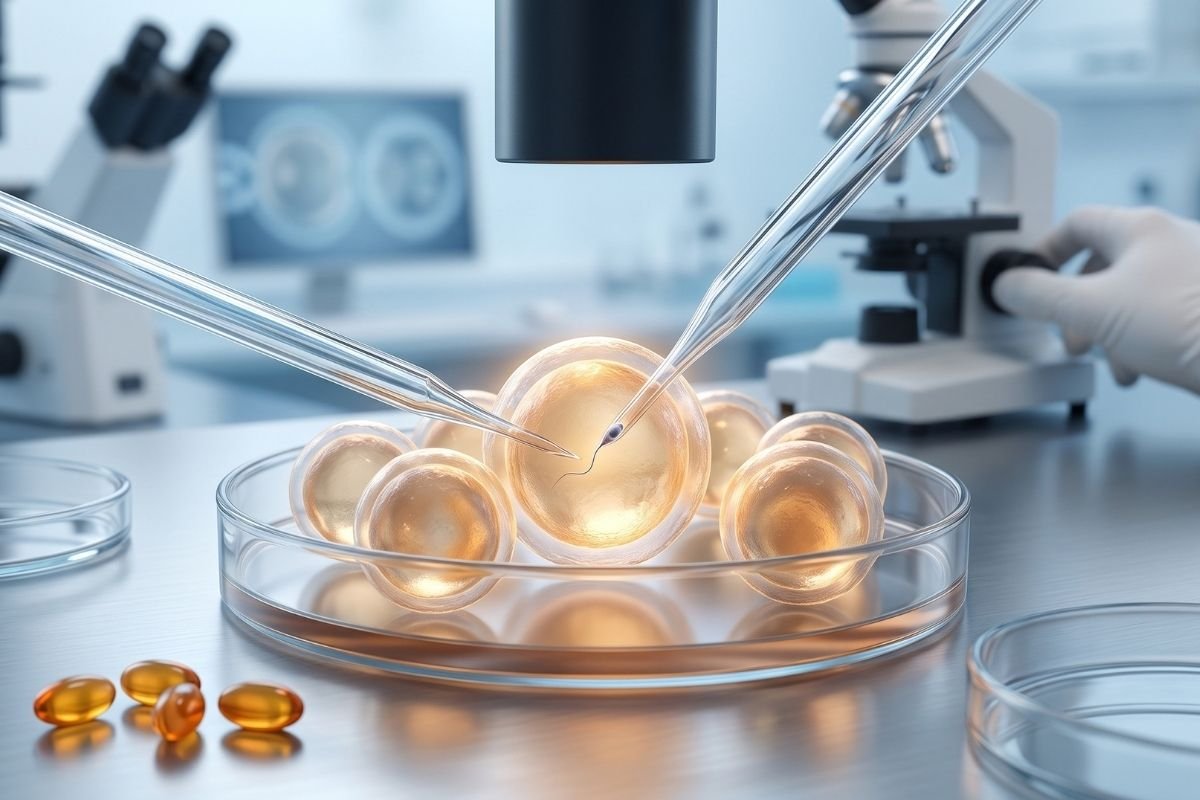
CoQ10 is the one egg quality supplement with real trial evidence behind it and that evidence is narrower than the marketing suggests.
In women with low ovarian reserve going through IVF, taking it beforehand increases the number of eggs collected and the number of good quality embryos. Whether that translates into more babies has not been shown.
Egg quality is the other half of the pair nobody can measure, alongside AMH, which we cover in how to read your fertility test results. This is the deep dive on the supplement half.
Why egg quality is not the same as egg count
No test measures egg quality directly, which is exactly why it is the easiest thing in fertility to sell you.
AMH and your antral follicle count estimate how many eggs are left. Neither says anything about how good they are, which is the whole argument of AMH is not a fertility score.
Quality mostly comes down to whether an egg divides its chromosomes correctly as it matures, and that tracks your age. In a review of 15,169 embryos screened before transfer, the proportion carrying the wrong number of chromosomes rose steadily from the late 20s onwards.¹ That was a retrospective IVF analysis, so it shows a pattern rather than proving a cause.
There is also a window. A follicle takes roughly 85 days, about three cycles, to travel from the early antral stage to ovulation.² The egg you release this month started that final stretch about three months ago, and that is the only period any supplement has to work in.
What the evidence says about CoQ10 and egg quality
The trials sit almost entirely in one group of women, and that matters when you read the results.
Does CoQ10 improve egg quality?
CoQ10 taken before an IVF cycle increases the number of eggs collected and the number of good quality embryos in women with low ovarian reserve.³
The best summary is a 2024 systematic review and meta-analysis pooling six randomised controlled trials and 1,529 women with diminished ovarian reserve.³ Women who took CoQ10 first had more eggs collected, more optimal embryos, fewer cancelled cycles and needed a lower total dose of stimulation medication.³
The largest single trial randomised 169 women under 35 with poor ovarian reserve to 600 mg of CoQ10 daily for 60 days before IVF, or to no pretreatment.⁴ Those who took it had more eggs retrieved, a higher fertilisation rate and fewer transfers cancelled for poor embryo development.⁴
Worth knowing: that trial was open label with no placebo, so everyone knew who was taking it, and the review authors flagged small sample sizes and poor reporting of methods across the whole set.³˒⁴
Does CoQ10 help you get pregnant?
CoQ10 is linked to a higher clinical pregnancy rate in IVF, and no trial has yet shown that it increases live births.
In the 2024 meta-analysis, clinical pregnancy was more likely with CoQ10, with an odds ratio of 1.84.³ Live birth was not among the outcomes the review was able to report, which is the gap that matters most to you. Miscarriage was lower, but the result sat right on the edge of statistical significance, so treat it as preliminary.³
In the largest trial, pregnancy and live birth rates were higher in the CoQ10 group but the difference was not statistically significant, meaning the trial was too small to tell.⁴
For context on supplements in this field, a Cochrane review of antioxidants in subfertile women rated the evidence low to very low quality, and Cochrane editors have since flagged concerns about 9 of the included studies, seven of which have been retracted.⁵ The loudest numbers here are often the least reliable ones.
Does CoQ10 work if you are not doing IVF?
No trial has tested whether CoQ10 improves your chance of conceiving without IVF, so using it that way is an extrapolation.
Every trial in the 2024 review recruited women already in IVF or ICSI, and most had diminished ovarian reserve.³ Nobody has run the equivalent study in women with normal reserve trying at home, which describes most people reading this.
The reasoning behind it is sound. In aged mice, eggs showed reduced mitochondrial function and declining quality, and CoQ10 supplementation reversed part of that decline.⁶ The same study found lower expression of two enzymes that make CoQ10 in older human eggs.⁶
If you are trying naturally, timing intercourse across your fertile window has far more evidence behind it than anything in a bottle.
How much CoQ10 should you take and for how long?
The trials that showed a benefit used 600 mg a day, taken as 200 mg three times daily, for 60 days before the IVF cycle.⁴
Across the wider literature doses generally run from 200 mg to 600 mg a day.³ Given that a follicle needs about 85 days to reach ovulation, a run-in of two to three months fits when a supplement could plausibly act, and it matches when the trials started.²
Which form is better absorbed is a separate question the fertility trials were not designed to answer, so the dose and the run-in matter more than the wording on the label.
One Australian point worth knowing. Supplements like this are listed medicines carrying an AUST L number. The TGA checks the ingredients and manufacturing, and does not evaluate the efficacy claims before the product goes on sale, because the sponsor certifies they hold that evidence themselves.⁷ An AUST L number is a safety and quality marker, not a verdict on whether it works.
Is CoQ10 safe to keep taking once you are pregnant?
There is very little safety data on CoQ10 in early pregnancy, which is why it is usually stopped at a positive test unless your doctor advises otherwise.
The one reasonable pregnancy trial randomised 235 women at increased risk of preeclampsia to 200 mg of CoQ10 daily or placebo, from 20 weeks until delivery.⁸ It was well tolerated and fewer women in the CoQ10 group developed preeclampsia.⁸
Two things that trial does not tell you. It started at 20 weeks, so the first trimester is precisely the period it does not cover, and it was a single trial in one high risk population that has not been replicated or adopted into Australian practice.⁸
So the honest position is that CoQ10 before conception has been studied and CoQ10 through early pregnancy has not. Take that question to your GP or fertility specialist, and MotherSafe can advise on medication and supplement exposures in pregnancy.
Planning a pregnancy?
Each week I create bonus content covering interesting pieces of research worth knowing before and during pregnancy. These are exclusive tips sent only to my email subscribers. Interested in joining?
What this means for you
If you are heading into IVF with low ovarian reserve, CoQ10 is the supplement in this category with the most credible evidence, and it is reasonable to raise with your specialist.³
Ask two questions when you do. What dose and for how long, given the trials used 600 mg a day for about two months beforehand, and when should I stop once I am pregnant.⁴
If you are trying to conceive without IVF, nobody has tested it in you. It is low risk and it is not free, and the things with better evidence are already on the preconception checklist.
Be sceptical of anything sold as reversing egg age or raising your AMH. Neither is something a supplement can do, and no test could confirm it if it were.
References
- Franasiak JM, Forman EJ, Hong KH, et al. The nature of aneuploidy with increasing age of the female partner: a review of 15,169 consecutive trophectoderm biopsies evaluated with comprehensive chromosomal screening. Fertil Steril. 2014;101(3):656-63.e1.
- Gougeon A. Dynamics of follicular growth in the human: a model from preliminary results. Hum Reprod. 1986;1(2):81-7.
- Lin G, Li X, Yie SLJ, et al. Clinical evidence of coenzyme Q10 pretreatment for women with diminished ovarian reserve undergoing IVF/ICSI: a systematic review and meta-analysis. Ann Med. 2024;56(1):2389469.
- Xu Y, Nisenblat V, Lu C, et al. Pretreatment with coenzyme Q10 improves ovarian response and embryo quality in low-prognosis young women with decreased ovarian reserve: a randomized controlled trial. Reprod Biol Endocrinol. 2018;16(1):29.
- Showell MG, Mackenzie-Proctor R, Jordan V, et al. Antioxidants for female subfertility. Cochrane Database Syst Rev. 2020;8:CD007807.
- Ben-Meir A, Burstein E, Borrego-Alvarez A, et al. Coenzyme Q10 restores oocyte mitochondrial function and fertility during reproductive aging. Aging Cell. 2015;14(5):887-95.
- Therapeutic Goods Administration. Listed complementary medicines. Canberra: Australian Government Department of Health and Aged Care.
- Teran E, Hernandez I, Nieto B, et al. Coenzyme Q10 supplementation during pregnancy reduces the risk of pre-eclampsia. Int J Gynaecol Obstet. 2009;105(1):43-5.
Written by Bella · BBiomedSc, MEpi · Clinical epidemiologist
I read pregnancy research so you do not have to. More about me
Published: 24th August 2026 · Last reviewed: 24th August 2026
How I review research: Editorial policy
Educational only, not medical advice. Full disclaimer
This article is for educational purposes only and does not constitute medical advice. Research findings describe patterns across populations and may not apply to you. Always discuss your own situation with your GP, midwife or obstetrician.