Haemoglobin and ferritin measure two different things and only one of them finds iron deficiency early.
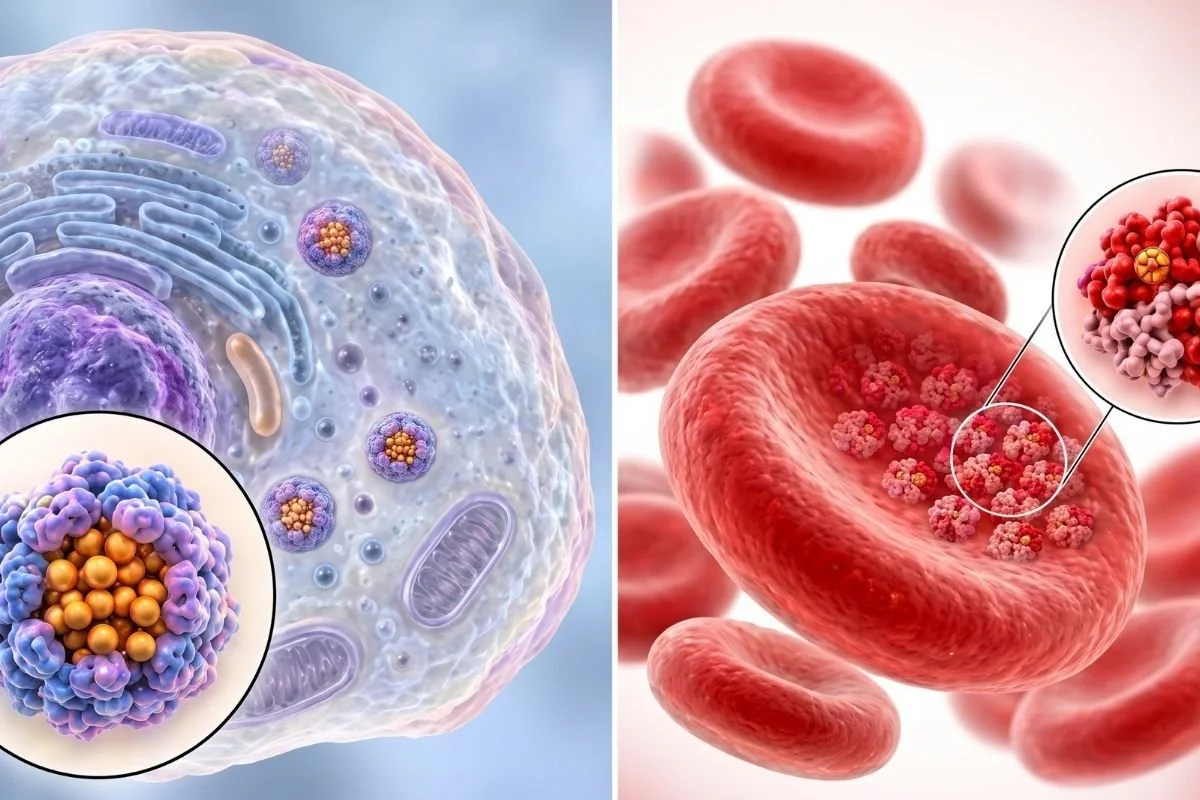
Haemoglobin measures the iron already working inside your red blood cells. Ferritin measures what you have left in storage, and your body empties the storage first to protect the red cells. So a full blood count can come back normal while your stores run down. If you already have a ferritin result, what is a normal ferritin in pregnancy covers how to read the number.
What does a full blood count measure?
A full blood count measures your red blood cells. It does not measure your iron stores.
The two parts discussed in relation to iron are haemoglobin, the oxygen-carrying protein inside your red cells, and mean cell volume, the average size of those cells.
Ferritin is different. It is the protein your body stores iron in, so measuring it tells you how much reserve you are holding.¹˒²
That matters because ferritin is not part of a full blood count. It is a separate test that must be requested separately, and in Australia it often is not.³
So “your bloods came back normal” can be accurate about a test that was never designed to find what you are asking about. How iron is assessed and treated here is in the iron and ferritin guide.
Does a normal blood test rule out iron deficiency in pregnancy? Does a normal haemoglobin mean your iron is fine?
No. The haemoglobin threshold used to flag anaemia picked up only about 30% of first-trimester iron deficiency in a study built to test exactly this question.⁴
That study retrospectively reviewed 20,550 pregnancies across three obstetrics clinics at one American university between 2009 and 2022. Among women who had both tests at their first visit, a haemoglobin below 110 g/L picked up 30% of those whose ferritin was below 30, with a confidence interval of 20 to 41%.⁴ Across the whole of pregnancy it reached 46%.⁴
Two caveats. The estimate rests on 345 women who had both tests around their first antenatal visit, so it is imprecise, and those women were not a random sample.⁴
The study also used one haemoglobin cut-off of 110 g/L throughout, while Australian guidance lowers it to 105 g/L after the first trimester.¹˒² A lower threshold flags fewer women, so our cut-off would not improve on this.
Can your red blood cells look normal when your iron is low?
Yes, and small red blood cells are a later sign than most people expect. In the same study, a mean cell volume below 80 detected only 11% of iron deficiency across pregnancy.⁴
In the first trimester it managed 30%, the same as haemoglobin.⁴ It falls away rather than improving because cell size stayed roughly stable as pregnancy went on, while iron deficiency among the women tested rose from 23.7% in the first trimester to 74.7% in the third.⁴
The combined figure is the one to remember. Of the women with first-trimester iron deficiency, 59.3% were neither anaemic nor had small red cells, and across pregnancy 50.5% had neither.⁴
A normal full blood count is not reassurance about your iron stores. It is silence about them.
Why is ferritin the test that finds it?
Ferritin measures stored iron directly, and tested against bone marrow iron it outperforms the other blood tests used to detect iron deficiency.⁵
Bone marrow sampling is the reference standard that blood tests are estimating. In the classic comparison, serum ferritin was by far the most powerful test, though that review covered patients investigated for anaemia rather than pregnant women.⁵
The pregnancy thresholds come from the guidelines. A ferritin below 30 should prompt treatment in pregnancy, and below 15 means stores are essentially empty.¹˒² The 2025 Australian consensus statement goes further and defines iron deficiency at that same 30.⁶
One honest limit. Ferritin rises with infection or inflammation anywhere in your body, so a recent illness can lift a genuinely low result into the normal range.¹˒² A low ferritin is almost always real. A borderline one taken while you were unwell is worth repeating.
Want to keep up to date with the latest evidence in the pregnancy space?
I read the Australian guidelines and the studies behind them, then send one clear email to my subscribers each week. This includes bonus information and breakdowns of new studies relevant to you during your pregnancy. Interested in subscribing?
Why this gets missed in Australian antenatal care
Which iron test will you actually be offered?
A full blood count at your first visit, with ferritin added only if your mean cell volume comes back low.
That is RANZCOG’s routine antenatal assessment guideline: a full blood count at the first visit, a repeat haemoglobin and platelet count at 28 weeks, then ferritin named only when mean cell volume is low.³
Read that next to the figures above and the problem is circular: the trigger for ordering the test that finds iron deficiency is the result of the test that detects 11% of it.⁴
Australian practice is moving. The 2025 consensus statement from the Haematology in Obstetrics and Women’s Health Collaborative recommends ferritin for all pregnant women at booking and again at 24 to 28 weeks, graded 1C, a strong recommendation on low quality evidence.⁶ That openly differs from RANZCOG, and from the UK guideline, which advises against testing ferritin in everyone.²
Practice lags both. In an audit at a regional New South Wales hospital, only 5.3% of the 103 women with screening records available had completed the full recommended screening.⁷
Can you feel iron deficiency before you are anaemic?
Yes. Tiredness, low mood and poor concentration are recognised effects of iron deficiency in adults, and the Australian consensus statement notes that tissue iron deficiency sets in long before anaemia appears.⁶
Trial evidence supports treating it. A meta-analysis pooled six randomised placebo-controlled trials of iron in non-anaemic women and found fatigue improved, with an effect size of 0.33 and a confidence interval of 0.17 to 0.48.⁸ In the best known of them, 144 women with unexplained fatigue were randomly assigned to iron or placebo, and fatigue fell by 29% on iron against 13% on placebo after one month.⁹
The calibration matters. Those trials were in non-pregnant women, each set its own definition of low iron, and two did not check iron status on entry.⁸ The same review’s cross-sectional studies found no association at all.⁸ None of this sets a ferritin target for pregnancy.
What they do support is that feeling flattened with a normal haemoglobin is measurable and treatable, not a reason to be dismissed.
What this means for you
Ask for the test by name, not for a verdict. “Can I have a ferritin level, not just a full blood count” is a request your GP or midwife can act on, where “are my iron levels okay” will be answered from the full blood count you already had.
If you were told your bloods were normal and you still feel exhausted, the useful follow-up is whether ferritin was measured at all. A normal haemoglobin does not answer that question.
Reasonable timing is your booking visit and again at 24 to 28 weeks, which is what the Australian consensus statement recommends.⁶ If you are still planning a pregnancy, the tests worth asking for are in preconception blood tests, and the questions worth raising early are in the first trimester checklist.
Your GP, midwife or obstetrician can interpret your own results in context.
References
- SA Health. Perinatal anaemia and iron infusion. South Australian Perinatal Practice Guideline PPG018, version 1. Adelaide: Government of South Australia; 2022.
- Pavord S, Daru J, Prasannan N, et al. UK guidelines on the management of iron deficiency in pregnancy. Br J Haematol. 2020 Mar;188(6):819-30.
- Royal Australian and New Zealand College of Obstetricians and Gynaecologists. Routine antenatal assessment in the absence of pregnancy complications (C-Obs 3b). Version 12.1. Melbourne: RANZCOG; 2022.
- Chao HX, Zack T, Leavitt AD. Screening characteristics of hemoglobin and mean corpuscular volume for detection of iron deficiency in pregnancy. Obstet Gynecol. 2025 Jan;145(1):91-4.
- Guyatt GH, Oxman AD, Ali M, et al. Laboratory diagnosis of iron-deficiency anemia: an overview. J Gen Intern Med. 1992 Mar-Apr;7(2):145-53.
- Clarke L, Froessler B, Tang C, et al. Iron optimisation in pregnancy: a Haematology in Obstetric and Women's Health Collaborative consensus statement. Intern Med J. 2025 Feb;55(2):300-7.
- Ebrahim M, Vadive PD, Dutton T, et al. Retrospective audit compares screening and treatment of pregnancy-related anaemia in regional New South Wales with Australian guidelines. BMC Pregnancy Childbirth. 2024;24:457.
- Yokoi K, Konomi A. Iron deficiency without anaemia is a potential cause of fatigue: meta-analyses of randomised controlled trials and cross-sectional studies. Br J Nutr. 2017 May;117(10):1422-31.
- Verdon F, Burnand B, Fallab Stubi CL, et al. Iron supplementation for unexplained fatigue in non-anaemic women: double blind randomised placebo controlled trial. BMJ. 2003 May 24;326(7399):1124.
Written by Bella · BBiomedSc, MEpi · Clinical epidemiologist
I read pregnancy research so you do not have to. More about me
Published: 26th October 2026 · Last reviewed: 26th October 2026
How I review research: Editorial policy
Educational only, not medical advice. Full disclaimer
This article is for educational purposes only and does not constitute medical advice. Research findings describe patterns across populations and may not apply to you. Always discuss your own situation with your GP, midwife or obstetrician.