Preconception blood tests: what to ask your GP for
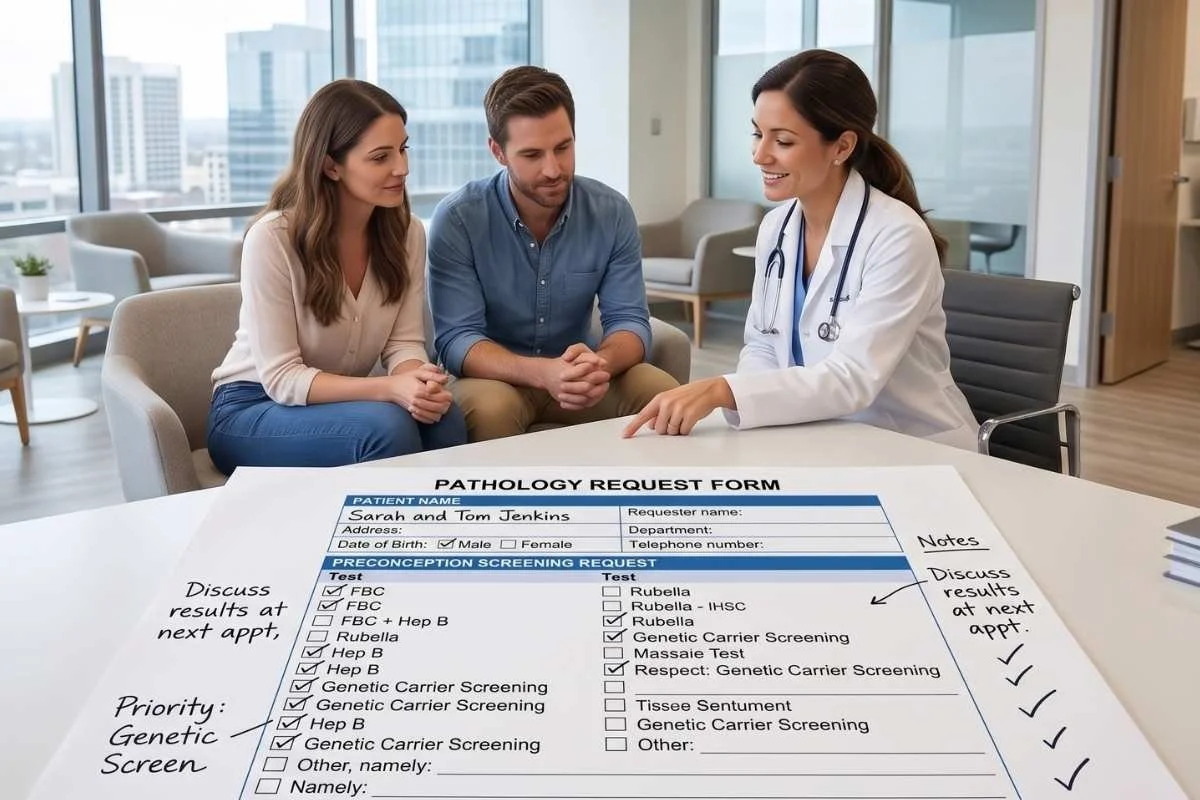
Almost every blood test offered at your first antenatal visit can be done before you conceive instead. The core panel covers immunity to rubella and chickenpox, screening for hepatitis B, hepatitis C, HIV and syphilis, your blood group and antibody status, a full blood count and ferritin.¹˒²
Doing them early means anything that needs correcting gets found while you still have time to act on it. Here is what each one is for, and which test to request by name, as part of the wider Australian preconception checklist.
The preconception blood panel, at a glance
The standard preconception panel is the same set of tests recommended at a first antenatal visit, moved earlier.
RANZCOG's pre-pregnancy counselling guidance recommends checking rubella immunity and screening for HIV, hepatitis B, hepatitis C and syphilis before pregnancy, and considering varicella (chickenpox) immunity and chlamydia screening.² The Australian Pregnancy Care Guidelines recommend the same infection screening at the first antenatal visit, along with a full blood count, blood group and antibody screen, and iron studies.¹
So the list to take to your GP is:
Rubella and varicella immunity
Hepatitis B, hepatitis C, HIV and syphilis
Blood group and antibody screen
Full blood count
Ferritin
Chlamydia screening, if relevant to you
One blood draw covers all of it. Most of it is bulk billed or Medicare rebated through a standard GP request, though pathology billing does vary, so it is worth asking when you book.
What each preconception blood test is actually for
Each test on the panel answers a different question, and two of them are the reason to test before pregnancy rather than during it.
Which preconception tests check my immunity, and why do they matter now?
Rubella and varicella immunity are checked first because the fix has a waiting period attached. Both vaccines are live vaccines, they are not given during pregnancy, and the Australian Immunisation Handbook advises avoiding pregnancy for 28 days afterwards.³
If your antibody levels come back low, you need that window before you start trying. Finding out at eight weeks pregnant means you cannot be vaccinated until after birth, and rubella infection in early pregnancy carries a real risk to a developing baby.
Immunity can also fade. Antibody levels decline over time, particularly after vaccination rather than natural infection, so a result from a previous pregnancy or your childhood records is not a substitute for testing now.¹
Hepatitis B, hepatitis C, HIV and syphilis screening are offered to everyone, not because of anything about you.² Knowing early matters because effective treatment exists for all four, and treatment during pregnancy substantially reduces the chance of passing an infection to your baby.
Why do I have to ask for ferritin by name?
Ferritin measures your iron stores, and it is not included in a standard full blood count. A full blood count measures haemoglobin, which is the iron already in use, not the reserve behind it.
That distinction is the reason so many women are told their iron is fine when their stores are running low. Haemoglobin falls last. By the time it drops, the stores have usually been empty for a while.
The Royal College of Pathologists of Australasia defines iron deficiency as a ferritin below 30 micrograms per litre.⁴ Many laboratory reports still flag ferritin as low only below roughly 15, so a result of 20 can be printed inside the normal range while meeting the Australian definition of deficiency.⁵
Iron deficiency is common in Australian pregnancy. A practice improvement project found routine ferritin screening identified deficiency in 60% to 70% of pregnant women at that threshold.⁵
We cover what your number means, and how long correcting it takes, in our guide to ferritin before pregnancy.
What does the blood group and antibody screen tell you?
Your blood group test identifies whether you are Rh D negative, which affects your care in pregnancy rather than your ability to conceive.
If you are Rh D negative and your baby is Rh D positive, your immune system can produce antibodies against your baby's red blood cells. This is preventable with anti-D injections, given routinely during pregnancy and after birth in Australia.
The antibody screen looks for antibodies you may already carry from a previous pregnancy or transfusion. It is repeated in every pregnancy for that reason.¹
Knowing your blood group before you conceive does not change what happens next, but it removes one unknown, and it is a single line on the same request form.
Planning a pregnancy?
Each week I create bonus content covering interesting pieces of research worth knowing before and during pregnancy. These are exclusive tips sent only to my email subscribers. Interested in joining?
The tests that are not routine, and why that is appropriate
Vitamin D and thyroid function are not recommended as routine tests for everyone, and that is a considered position rather than an oversight.
The Australian Pregnancy Care Guidelines recommend against routine vitamin D screening, advising it only for women with specific risk factors such as darker skin, very limited sun exposure or a BMI above 40.¹ Routine thyroid testing is likewise not recommended, with TSH testing reserved for women who have risk factors for thyroid problems.¹
The reasoning is that testing everyone for something uncommon produces more borderline results than genuine findings, and borderline results generate anxiety, repeat tests and sometimes treatment that was never needed.
This is where your own history matters. If you have a thyroid condition, a family history of one, type 1 diabetes, or you have had recurrent miscarriage, ask. Testing should follow your risk, not a template.
Where the guidelines disagree on ferritin
Australian guidance is not unanimous on ferritin screening and it is worth knowing that before you ask.
The Haematology in Obstetrics and Women's Health Collaborative consensus statement, published in 2025 and endorsed by the RCPA and the RACGP, recommends routine ferritin screening for all pregnant women at booking and again at 24 to 28 weeks.⁵ RANZCOG has recommended screening for iron deficiency once anaemia develops.⁵
The consensus authors graded their own 30 microgram threshold as GRADE 1D, meaning a strong recommendation resting on very low certainty evidence. They say so plainly, and so do we. Several authors also declared speaker fees from iron manufacturers, which is disclosed in the paper.⁵
None of that makes the recommendation wrong. It makes it a reasonable position on limited evidence, and the same group's closing point is the one that matters here: correcting iron before pregnancy is easier than correcting it during.⁵
What this means for you
Book a long GP appointment and ask for a preconception blood panel. Bring the list above written down, and add ferritin explicitly, because it is the one most likely to be left off.
Ask for your actual numbers rather than "normal." If your ferritin is under 30, ask what the plan is and when it will be rechecked, because building stores back up takes months rather than weeks.
Use the same visit for the rest of the preconception work: reproductive genetic carrier screening, a check of your vaccination status, a review of any regular medications, and confirming your cervical screening is current. Cervical screening in Australia is a five-yearly test for women aged 25 to 74, and it is simpler to do before pregnancy than during.⁶
One appointment, one blood draw and most of the checklist is done.
References
- Australian Government Department of Health and Aged Care. Clinical practice guidelines: pregnancy care. Canberra: Department of Health and Aged Care; 2020.
- Royal Australian and New Zealand College of Obstetricians and Gynaecologists. Pre-pregnancy counselling (C-Obs 3a). Melbourne: RANZCOG.
- Australian Technical Advisory Group on Immunisation. Vaccination for women who are planning pregnancy, pregnant or breastfeeding. In: Australian immunisation handbook. Canberra: Department of Health and Aged Care.
- Royal College of Pathologists of Australasia. Position statement: the use of iron studies, ferritin and other tests of iron status. Sydney: RCPA; 2020.
- Clarke L, Froessler B, Tang C, et al. Iron optimisation in pregnancy: a Haematology in Obstetric and Women's Health Collaborative consensus statement. Intern Med J. 2025 Feb;55(2):300-307.
- Australian Government Department of Health and Aged Care. National Cervical Screening Program. Canberra: Department of Health and Aged Care.
Written by Bella · BBiomedSc, MEpi · Clinical epidemiologist
I read pregnancy research so you do not have to. Australian evidence, no scare tactics. More about me
Published: 18 July 2026 · Last reviewed: 18 July 2026
How I review research: Editorial policy
Educational only, not medical advice. Full disclaimer
This article is for educational purposes only and does not constitute medical advice. Research findings describe patterns across populations and may not apply to you. Always discuss your own situation with your GP, midwife or obstetrician.