Vaccinations before pregnancy: which ones, and when
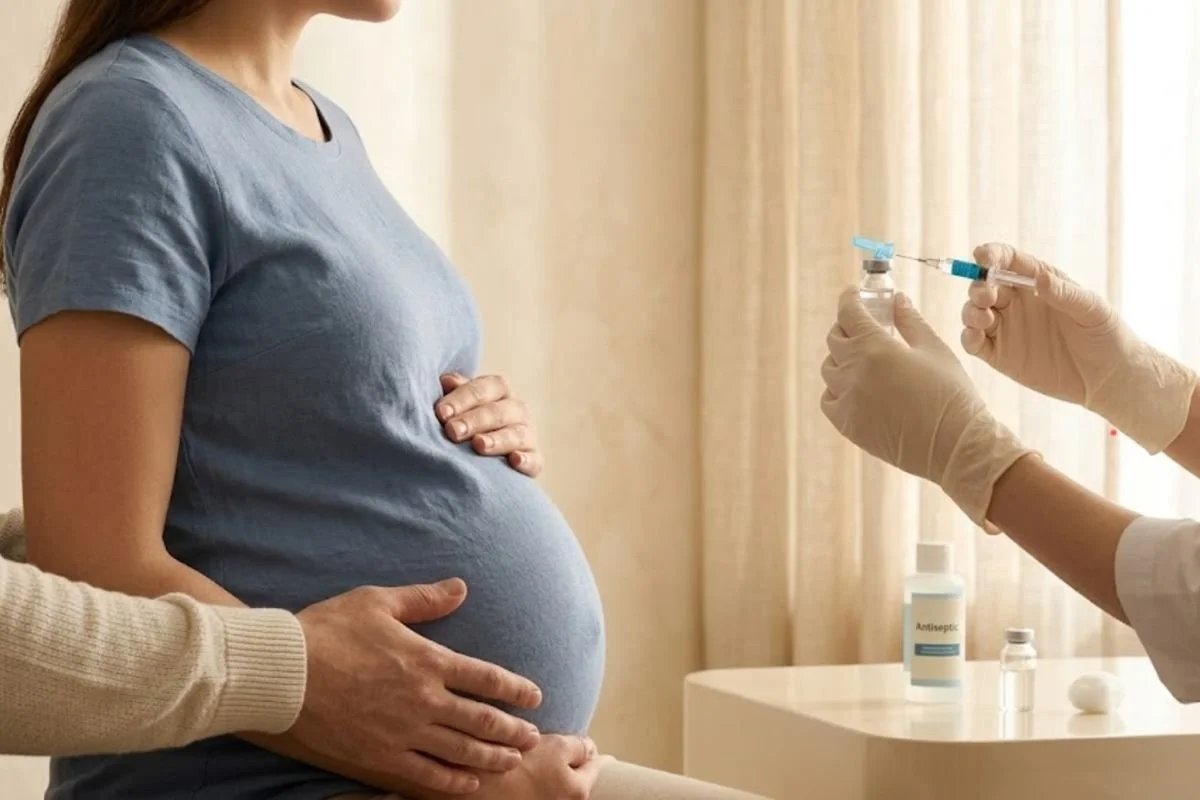
Two vaccines need to be sorted before you conceive: measles-mumps-rubella (MMR) and chickenpox (varicella). Both are live vaccines, neither is given during pregnancy, and after either one the Australian Immunisation Handbook advises avoiding pregnancy for 28 days.¹
That waiting period is why vaccination sits in the three-month column of the Australian preconception checklist, not the last-minute one. Here is what to check, what the 28 days is actually based on, and which vaccines are deliberately saved for pregnancy.
Which vaccinations should you check before pregnancy?
The Australian Immunisation Handbook recommends having your vaccination status assessed before pregnancy for hepatitis B, measles, mumps, rubella, varicella and COVID-19.¹ RANZCOG's pre-pregnancy counselling guidance makes the same point, and adds whooping cough immunity to the list to consider.²
Of these, only MMR and varicella carry a waiting period, because only those two are live vaccines. The rest can be given at any point, including during pregnancy, if you need them.
So the preconception vaccination list is short:
MMR, if you are not immune to rubella or measles
Varicella, if you are not immune to chickenpox
Hepatitis B, if you are not immune and at increased risk
COVID-19, if you have never been vaccinated
Everything else belongs to pregnancy itself, and is covered further down. If you are working through the checklist in order, this sits alongside starting folate and iodine and booking your bloods.
The 28-day window after a live vaccine
Three questions come up about the wait, and the answers are more reassuring than the rule itself sounds.
Why is there a 28-day wait after the MMR or chickenpox vaccine?
The 28-day wait exists because both vaccines contain a weakened live virus, and the concern is theoretical rather than something that has been observed.
Live vaccines are avoided in pregnancy because of the hypothetical risk that the vaccine virus replicates in a developing baby. The Handbook is unusually direct about the strength of the evidence behind the 28 days: the interval comes from the vaccine product information and is not supported by clinical data.¹
For chickenpox specifically, the Handbook notes that the risk of congenital varicella syndrome is hypothetical, and that babies born to women inadvertently given the vaccine in early pregnancy have not had it.¹
None of that makes the rule pointless. It is a sensible precaution and it costs nothing if you plan for it. It does mean the wait is about caution rather than a known danger, which is worth knowing if the timing feels frustrating.
What if I was vaccinated and then found out I was already pregnant?
If a live vaccine was given shortly before or during early pregnancy, the risk is considered theoretical, and the Handbook states plainly that termination does not need to be considered.¹
The largest body of evidence behind that comes from United States surveillance that followed women who received rubella-containing vaccine around the time of conception between 1971 and 1988. Among 321 susceptible women who were vaccinated and continued their pregnancies, no baby was born with congenital rubella syndrome.³
That is observational surveillance rather than a trial, so it cannot prove the risk is zero. What it can do is put an upper bound on it, and after several decades of accidental exposures no pattern of harm has appeared.
Practically: tell your GP, who can report it to the TGA, and ask for a referral to MotherSafe if you want to talk it through with an obstetric medicines service.
How do I know whether I am already immune?
A blood test can check your immunity to measles, mumps, rubella and hepatitis B, and it can be done at the same draw as your other preconception blood tests.¹
Varicella is the exception, and this is the part most content leaves out. The Handbook states that routine varicella serology does not reliably measure vaccine-induced immunity, although it can show immunity from having had chickenpox naturally.¹
In practice that means a low varicella result in someone who was vaccinated as a child does not necessarily mean you are unprotected, and your GP will weigh your vaccination history alongside the number rather than treating the result as the whole answer.
Rubella is different again. Antibody levels fall over time, particularly after vaccination rather than natural infection, so a result from your childhood records is not a substitute for testing now.
Planning a pregnancy?
Each week I create bonus content covering interesting pieces of research worth knowing before and during pregnancy. These are exclusive tips sent only to my email subscribers. Interested in joining?
Which vaccines are given during pregnancy instead?
Three vaccines are recommended in every pregnancy rather than before it, because the point of them is to pass antibodies across the placenta to your baby.
Why is the whooping cough vaccine given during pregnancy and not before?
Whooping cough vaccine (dTpa) is recommended as a single dose in each pregnancy, ideally between 20 and 32 weeks, because the antibodies you make in response cross the placenta and protect your baby in the months before they can be vaccinated themselves.¹
The effect is large. An observational study of the English maternal vaccination programme found vaccine effectiveness of 91% (95% confidence interval 84 to 95) against confirmed whooping cough in babies under three months born to vaccinated mothers.⁴ Being observational, it shows a strong association rather than proving causation, but the finding has been consistent across programmes.
Timing matters more than most people realise. Protection is lower if the vaccine is given within two weeks of birth, which is why the recommendation sits at 20 to 32 weeks rather than at term.¹ It is free under the National Immunisation Program in every pregnancy.
Is the RSV vaccine in pregnancy new?
Yes. The maternal RSV vaccine (Abrysvo) is recommended as a single dose between 28 and 36 weeks, and has been free under the National Immunisation Program since February 2025.¹˒⁶
The evidence comes from a randomised placebo-controlled trial across 18 countries, funded by the manufacturer, Pfizer.⁵ ATAGI's summary of it is that efficacy against RSV hospitalisation in infants was 57% for up to six months after birth.¹
The lower gestational limit has a specific reason behind it. Vaccination before 28 weeks is not recommended as a precaution, because an imbalance in preterm births and newborn deaths was seen in low- and middle-income countries during a trial of a different maternal RSV vaccine that was discontinued.¹ ATAGI describes no conclusive evidence of a difference in preterm birth in the Abrysvo trials themselves.
Influenza vaccine is the third, recommended at any stage of pregnancy and in every pregnancy.¹
Is it safe for my family to be vaccinated while I am pregnant?
Yes. Household contacts of pregnant women should be vaccinated on schedule, including with MMR, varicella, zoster and rotavirus vaccines.¹
Measles, mumps and rubella vaccine viruses are not transmitted from a vaccinated household contact to a pregnant woman.¹ For chickenpox and shingles vaccines the risk of transmission is described as almost negligible, with one practical caveat: if the person vaccinated develops a chickenpox-like rash, they should keep it covered around you.¹
Rotavirus vaccine, given to babies, carries a very small possibility of transmission to pregnant contacts. ATAGI's position is that the benefit of protecting the infant clearly outweighs that theoretical risk.¹
This comes up most often when an older child is due for their 12-month or 18-month vaccines during a pregnancy. Those appointments go ahead as scheduled, and delaying them leaves the child unprotected without making you any safer.
What this means for you
Book a long GP appointment about three months before you plan to start trying and ask for measles, rubella and hepatitis B serology as part of your preconception bloods.
If a result comes back low, have the vaccine and count 28 days before you start trying. That is the entire delay and it only exists if you leave it until the month you begin.
If you are already pregnant and not immune, the live vaccines wait until after the birth. They are safe while breastfeeding, and most maternity services will offer them before you go home.
Then put whooping cough, influenza and RSV in the diary for pregnancy itself. Your GP or midwife can time them for you, and all three are funded.
References
- Australian Technical Advisory Group on Immunisation. Vaccination for women who are planning pregnancy, pregnant or breastfeeding. In: Australian immunisation handbook. Canberra: Department of Health and Aged Care; updated 16 August 2024.
- Royal Australian and New Zealand College of Obstetricians and Gynaecologists. Pre-pregnancy counselling (C-Obs 3a). Melbourne: RANZCOG.
- Centers for Disease Control and Prevention. Rubella vaccination during pregnancy, United States, 1971-1988. MMWR Morb Mortal Wkly Rep. 1989 May 5;38(17):289-293.
- Amirthalingam G, Andrews N, Campbell H, et al. Effectiveness of maternal pertussis vaccination in England: an observational study. Lancet. 2014 Oct 25;384(9953):1521-1528.
- Kampmann B, Madhi SA, Munjal I, et al. Bivalent prefusion F vaccine in pregnancy to prevent RSV illness in infants. N Engl J Med. 2023 Apr 20;388(16):1451-1464.
- Australian Government Department of Health, Disability and Ageing. Respiratory syncytial virus (RSV) vaccine. Canberra: Department of Health, Disability and Ageing.
Written by Bella · BBiomedSc, MEpi · Clinical epidemiologist
I read pregnancy research so you do not have to. Australian evidence, no scare tactics. More about me
Published: 18 July 2026 · Last reviewed: 18 July 2026
How I review research: Editorial policy
Educational only, not medical advice. Full disclaimer
This article is for educational purposes only and does not constitute medical advice. Research findings describe patterns across populations and may not apply to you. Always discuss your own situation with your GP, midwife or obstetrician.