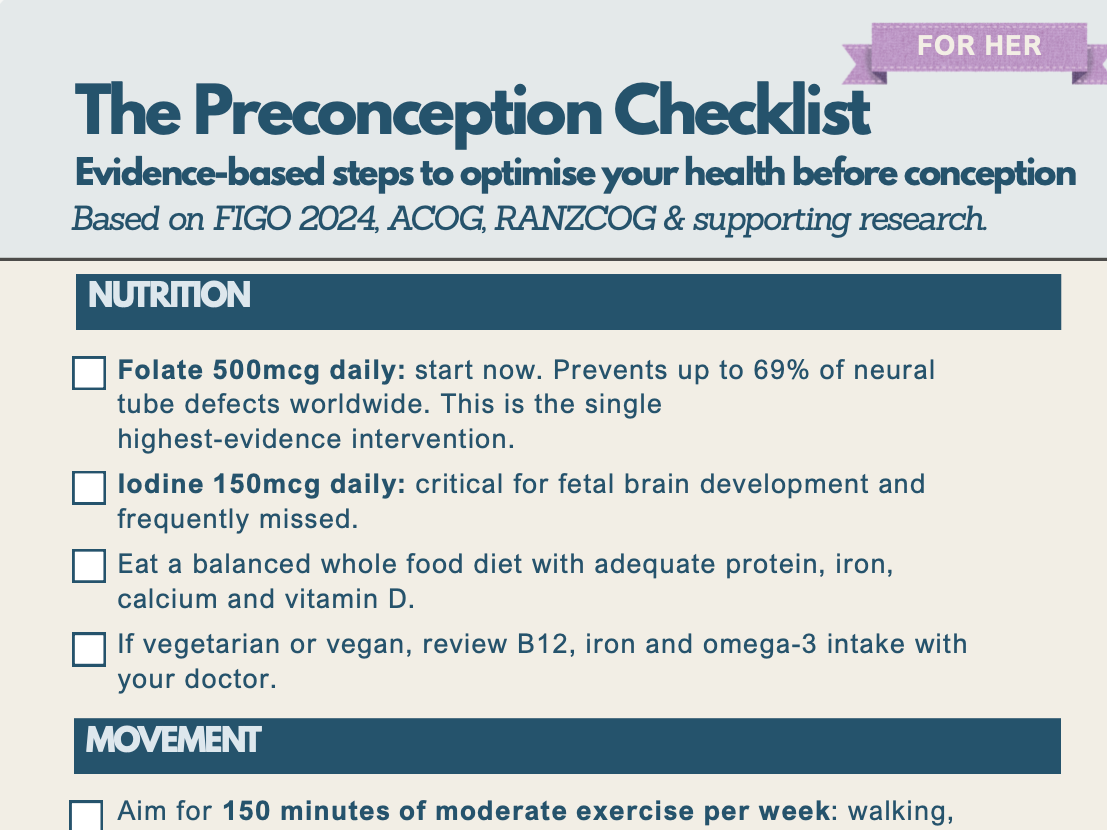
Preconception care is the short list of things worth sorting out in the 3 months before you start trying. A folic acid and iodine supplement, a GP appointment, a handful of blood tests, your vaccination status and, if you want it, carrier screening.
Most of it is inexpensive. Some of it is covered by Medicare. Here is what Australian guidelines recommend.
Why preconception care matters, and when to start
The most useful window for preconception care is the 3 months before you start trying, because almost everything on the list takes weeks to take effect.
Folic acid is the clearest example. The neural tube, which becomes your baby's brain and spinal cord, forms in the first few weeks after conception, often before a pregnancy test turns positive.
RANZCOG recommends folic acid for at least the month before a planned pregnancy, not from the day you get a positive test.¹
Live vaccines need a 28-day gap before conception.² Iron stores take months to rebuild, not days.³ Medication reviews sometimes mean switching to a different drug and checking that the new one holds your condition steady.¹
None of this is urgent in the way it sounds. It is simply a set of tasks that reward being done early.
The preconception checklist
There are 6 things on the Australian preconception checklist:
start folic acid and iodine,
book a pre-pregnancy GP visit,
get your baseline blood tests,
check your vaccination status,
consider reproductive genetic carrier screening and;
check your iron stores.
Two more sit alongside them:
review any regular medications, and;
get your partner involved rather than treating this as your project alone.
You do not need to do all of it in one appointment. Most women work through it across two GP visits, roughly three months apart, with the blood tests in between.
What supplements should I take before pregnancy?
Australian guidelines recommend two supplements before conception: at least 500 micrograms of folic acid daily and 150 micrograms of iodine daily.¹˒²
RANZCOG advises taking folic acid for at least the month before a planned pregnancy and through the first three months of pregnancy, to reduce the risk of neural tube defects such as spina bifida.¹
Some women are advised to take 5 milligrams of folic acid instead, a roughly tenfold higher dose. That applies if you have diabetes, take anticonvulsant medication for epilepsy, are obese, have a personal or family history of a neural tube defect, or have a condition that affects how well you absorb nutrients.¹
The iodine recommendation comes from the NHMRC, which advises 150 micrograms daily for all women who are pregnant, breastfeeding or considering pregnancy, because iodine supports your baby's brain development.⁴
If you have a thyroid condition, the NHMRC advises checking with your doctor before starting iodine.⁴
What blood tests should I ask my GP for before pregnancy?
A standard Australian preconception blood panel covers immunity, iron stores, thyroid function and blood group.
The Australian Immunisation Handbook specifically lists serological testing for hepatitis B, measles, mumps and rubella immunity where your vaccination history is uncertain.²
Varicella is the exception. Routine serology does not reliably measure vaccine-induced immunity to chickenpox, although it can show whether you have immunity from having had the infection.²
Beyond immunity, it is reasonable to ask for a full blood count and ferritin, thyroid function, vitamin D and your blood group and antibody status.
RANZCOG also recommends a blood pressure check, a general examination and cervical screening if you are due.¹
Not every test is bulk-billed, and what your GP orders will depend on your history. Going in with a written list helps, because a preconception visit is easy to compress into a 5-minute consult if you do not.
Should I check my ferritin before trying to conceive?
Yes, checking your ferritin before you conceive is worth doing and this is one area where the guidelines are quietly ahead of routine practice.
Ferritin measures your stored iron, which is a different thing from your haemoglobin. You can have a perfectly normal full blood count and still have empty iron stores.
Iron deficiency affects up to 70% of Australian pregnancies.³ The 2025 Australian consensus statement on iron in pregnancy defines deficiency as a ferritin below 30 micrograms per litre, which is higher than the threshold many Australian labs flag.³
That statement closes with an explicit call to action: optimising iron before pregnancy, rather than during it, means your stores are already adequate when demand rises.³
Rebuilding stores takes months of oral iron, not weeks.
Which vaccinations do I need before pregnancy?
The Australian Immunisation Handbook recommends assessing your status for hepatitis B, measles, mumps, rubella, varicella, COVID-19 and RSV as part of a pre-conception health check.²
The measles-mumps-rubella and varicella vaccines are live vaccines, which means they contain a weakened form of the virus. Live vaccines are contraindicated in pregnancy.²
If you need one, the Handbook advises avoiding pregnancy for 28 days afterwards.² RANZCOG phrases the same advice as at least four weeks.¹
This is the single most common reason a preconception plan needs a 3-month runway rather than a three-week one, because you may need two doses.
The Handbook states that the 28-day rule comes from vaccine product information and is not supported by clinical data.² If a live vaccine is given inadvertently just before or during a pregnancy, speak to your GP.
What is reproductive genetic carrier screening and does Medicare cover it?
Reproductive genetic carrier screening tells you whether you carry a gene change for a serious inherited condition without having the condition yourself. Since 1 November 2023, Medicare has covered a three-gene test for cystic fibrosis, spinal muscular atrophy and fragile X syndrome.⁵
Unlike most Medicare-funded genetic tests, this one does not require a family history. Any Medicare-eligible person who is pregnant or planning a pregnancy can have it, once in their lifetime.⁵
You are tested first, under MBS item 73451. Your partner is tested afterwards, under item 73452, only if you are found to carry cystic fibrosis or spinal muscular atrophy.⁵
The reason for that order is that fragile X is inherited differently, so your partner's fragile X status does not change your child's risk.⁵
The MBS fee is $400 with a benefit of $340, so whether you pay a gap depends on the laboratory. If you both test at the same time, only your test attracts the rebate.⁵
An Australian screening programme of 12,000 people found 5.08%, or about 1 in 20, were carriers, and roughly 88% of them had no family history.⁶
What should my partner do before we start trying?
Your partner's health affects both fertility and pregnancy outcomes, and RANZCOG says so explicitly.¹
The list is shorter but not trivial: stop smoking, reduce alcohol, review any regular medications and address weight and diet if relevant.¹
Smoking reduces sperm quality and in women it affects both egg quality and the number of healthy eggs remaining.¹
If carrier screening is on your list, your partner's testing comes second and only if needed, as above.⁵
This matters more than it is usually given credit for, because preconception advice in practice tends to land entirely on the woman. Half the genetic material comes from somewhere else!
What if I take regular medication?
Review your medications with your GP before you conceive, not after, and do not stop a long-term medication on your own.
RANZCOG is direct on this: avoid stopping long-term medication abruptly without discussing it with your doctor.¹
The reason is that for many conditions, the risk of the condition being poorly controlled in pregnancy is higher than the risk of the medication.
Diabetes is the clearest case. Good blood sugar control before conception and in the first three months lowers the risk of harm to the baby, so switching or adjusting treatment early is the point of the exercise.¹
Over-the-counter products and supplements count as medications here and are worth bringing to the appointment.¹
In Australia, MotherSafe and your pharmacist can both give medication-specific advice in pregnancy, and your GP can refer on if a specialist opinion is needed.
Planning a pregnancy?
Each week I create bonus content covering interesting pieces of research worth knowing before and during pregnancy. These are exclusive tips sent only to my email subscribers. Interested in joining?
What this means for you
Book a GP appointment and say you are planning a pregnancy, ideally around 3 months before you want to start trying.
Start a prenatal with at least 500 micrograms of folic acid and 150 micrograms of iodine now, whether or not the appointment is soon.
Ask for the blood tests in writing: full blood count and ferritin, thyroid function, vitamin D, blood group and antibodies and immunity to hepatitis B, measles, mumps and rubella.
Ask whether you need the MMR or varicella vaccine, and if so, plan for the 28-day gap.
Ask about Medicare-funded carrier screening, and ask the lab what the out-of-pocket cost will be.
If your ferritin is under 30, ask how to bring it up before you start trying rather than after.
And bring your partner, or at least the list, to one of these appointments.
References
1. Royal Australian and New Zealand College of Obstetricians and Gynaecologists. Planning for Pregnancy. Melbourne: RANZCOG; 2016. 2. Australian Technical Advisory Group on Immunisation. Vaccination for women who are planning pregnancy, pregnant or breastfeeding. In: Australian Immunisation Handbook. Canberra: Australian Government Department of Health and Aged Care; updated 16 Aug 2024. 3. Clarke L, Froessler B, Tang C, et al. Iron optimisation in pregnancy: a Haematology in Obstetric and Women's Health Collaborative consensus statement. Intern Med J. 2025;55(2):300-307. doi:10.1111/imj.16602 4. National Health and Medical Research Council. Iodine supplementation for pregnant and breastfeeding women. Public statement. Canberra: NHMRC; 2010. 5. Australian Government Department of Health and Aged Care. Reproductive carrier testing for cystic fibrosis, spinal muscular atrophy and fragile X syndrome. MBS Online factsheet. Canberra: Commonwealth of Australia; updated 22 Nov 2023. 6. Archibald AD, Smith MJ, Burgess T, et al. Reproductive genetic carrier screening for cystic fibrosis, fragile X syndrome, and spinal muscular atrophy in Australia: outcomes of 12,000 tests. Genet Med. 2018;20(5):513-523. doi:10.1038/gim.2017.134Written by Bella · BBiomedSc, MEpi · Clinical epidemiologist
I read pregnancy research so you do not have to. More about me
Published: 22nd September 2026 · Last reviewed: 22nd September 2026
How I review research: Editorial policy
Educational only, not medical advice. Full disclaimer
This article is for educational purposes only and does not constitute medical advice. Research findings describe patterns across populations and may not apply to you. Always discuss your own situation with your GP, midwife or obstetrician.